Movie Sound Effects: Foley, Impacts and Cinematic Details

Movie sound effects are the part of filmmaking that makes the picture feel touchable. A hand grabs a jacket and we hear cloth. A character crosses a room and we hear weight, floor, distance, and confidence. A door closes and the scene suddenly has privacy, danger, comedy, or finality.
The useful way to think about movie SFX is not "find the sound of the object." It is "find the sound of the moment." A door can be gentle, expensive, haunted, cheap, angry, safe, or exhausted. A footstep can tell us someone is sneaking, rushing, injured, powerful, or trying not to wake a child. A sound effect is doing its job when it makes the audience understand something faster than dialogue could explain it.
Use the player below to preview and download 20 royalty-free movie sound effects for short films, trailers, student films, YouTube scenes, games, pitch videos, and social edits. Then use this guide to choose, layer, time, and mix sounds so they support the story instead of simply filling silence.
What counts as a movie sound effect?
In film and video post-production, sound effects cover almost everything that is not dialogue or score. Some are literal recordings. Some are foley performed in sync with picture. Some are designed from layers that never happened in the real world. A punch might include cloth movement, skin slap, a vegetable crack, a low thud, and a short whoosh. A spaceship door might begin as a drawer, a metal scrape, an air release, and a pitched servo.
| Sound type | What it does | Examples |
|---|---|---|
| Foley | Adds human sync and texture | Footsteps, cloth, hand props, body movement |
| Hard effects | Defines visible objects | Doors, glass, cars, tools, weapons, hits |
| Ambience | Creates place and continuity | Room tone, street beds, wind, crowds, interiors |
| Designed effects | Creates heightened or impossible sounds | Magic, monsters, sci-fi tech, dreams, glitches |
| Transitions | Moves us through cuts and reveals | Whooshes, risers, reverses, swells, stingers |
| Impacts | Adds weight and punctuation | Trailer hits, booms, thuds, title-card impacts |
The categories are useful, but they are not the point. In a real scene, they overlap. A horror hallway might need quiet room tone, a distant pipe, a soft shoe scuff, a door latch, and one low designed texture that makes the space feel unsafe. The audience does not label those sounds. They feel the hallway.
Spot the scene before searching the library
The fastest way to make a scene sound generic is to search for the loudest file first. Start by watching the scene with no added effects. Mark three things: visible actions, emotional turns, and point of view.
Visible actions are the obvious sync points: footsteps, doors, props, vehicles, punches, cloth, glass, tools, phones, and movement. Emotional turns are the beats where the audience learns something: a character notices a clue, loses confidence, enters danger, makes a choice, or realizes they are not alone. Point of view tells you whose ears matter. Are we hearing the room objectively, or are we inside the character's anxiety?
Once those questions are clear, searching gets easier. You are no longer looking for "door slam." You are looking for "small apartment door, close perspective, tired but final." That search may lead to a real door, a cabinet, a car door, or a layered latch and low thud. The object matters, but the story job matters more.
Foley makes movie sound effects feel human
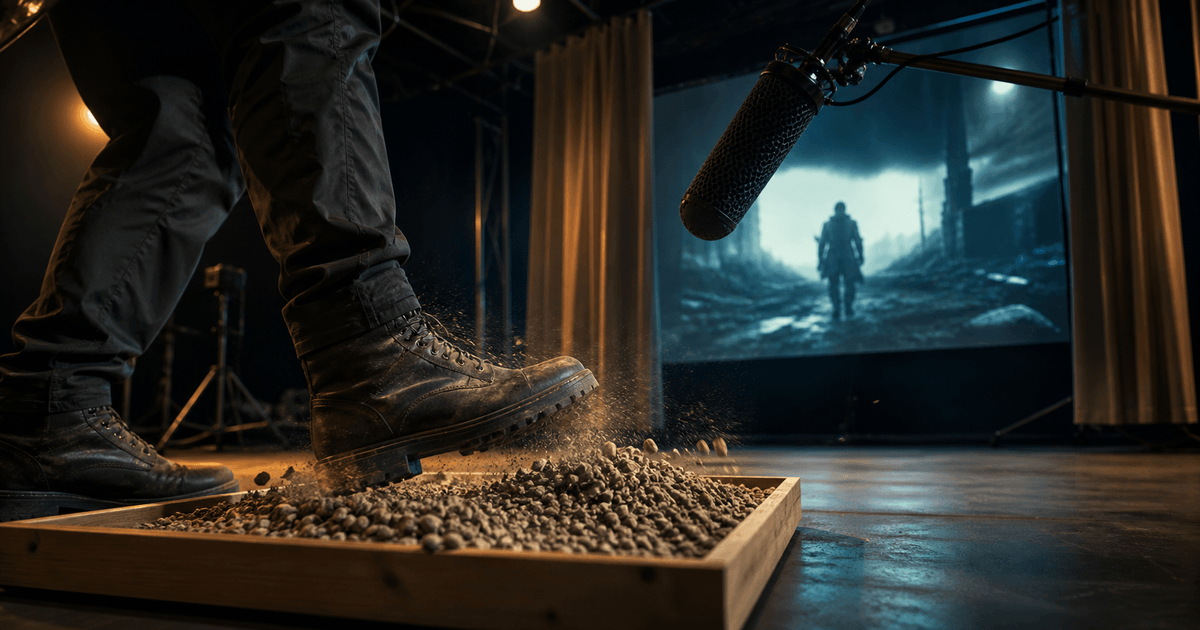
Foley is the art of performing sound to picture. Footsteps, cloth, hand props, and body movement are often more convincing when they are played by a human watching the scene. That human timing matters. A footstep is not just a shoe hitting floor. It is hesitation, confidence, fear, weight, limp, speed, and attitude.
When a scene feels oddly empty, it is often missing foley. You can have beautiful dialogue and music, but if hands, clothes, props, and bodies do not make sound, people start to feel like ghosts. A jacket sleeve, a nervous cup touch, a chair creak, or a hand gripping leather can make an actor feel present again.
Use foley to support performance, not to prove that every object exists. A nervous character may fidget with a glass. A villain may move slowly and cleanly. An exhausted parent may drop objects with less precision. These choices are tiny, but they make the picture feel acted through sound.
Movie sound effects examples to study
Foley artists building movie detail
Watch how physical performance turns ordinary props into believable screen action. The important lesson is not that you need the exact same objects. The lesson is that sync, texture, and intention make the sound read. The artist is not just making noise; they are performing the actor's movement.
How familiar movie sounds are made
Many iconic movie sounds are built from unexpected sources. This is useful permission for editors: if the sound sells the story, it does not need to be literally correct. A vegetable can become a body hit. A metal object can become machinery. A processed animal layer can make a creature feel alive.
Stylized animation makes every choice audible
Animation makes the principle obvious because every sound is chosen. Listen for how timing, exaggeration, and texture make actions feel clear even when the world is stylized. Live action works the same way, just with a lower tolerance for sounds that call attention to themselves.
Build a movie scene in passes
A sound pass is easier when you build from the floor up.
- Spot the scene. Watch without adding anything. Mark visible actions, emotional turns, location changes, and cuts that need punctuation.
- Lay in ambience first. A room, street, forest, hallway, or car bed gives the scene continuity.
- Add foley for human movement. Footsteps, cloth, hands, and props make the bodies real.
- Add hard effects for visible objects. Doors, tools, glass, vehicles, impacts, and mechanisms should match size and distance.
- Design the important moments. Use layers for hits, reveals, magic, fear, comedy, or scale.
- Mix from the story outward. Dialogue first, then the sounds the audience must understand, then flavor.
If the scene starts to feel busy, mute every effect and rebuild. Add only the sounds the audience needs for clarity. Then add the sounds the audience should feel. That order keeps the mix from turning into wallpaper.
Layer cinematic impacts without making mud
A cinematic hit usually needs a transient, body, and tail. The transient gives the ear a clear start. The body gives weight. The tail places the hit in a room or world. If all three layers are huge, the result turns into mud. Let each layer do one job.
- Transient: snap, crack, slap, metal tick, or short punch.
- Body: thud, boom, wood impact, low drum, or processed hit.
- Tail: room, debris, dust, reverb, echo, or ringing metal.
For related layers, start with thud sound effects, glass breaking sound effects, dramatic sound effects, and explosion sound effects.
The key is restraint. A title card can take a huge hit. A character setting a mug down probably cannot. A fight scene needs variation: cloth before contact, a short crack for the hit, a low thud for body, and maybe a room tail if the impact changes the space. Using one oversized boom for every contact makes action feel cheaper, not bigger.
Perspective is half the sound
A sound effect is not finished when the file matches the object. It also has to match camera distance, room size, point of view, and story focus. A key turning in a close-up can be dry, detailed, and almost uncomfortable. The same key across a room may need only a small metal tick or nothing at all. A huge footstep in a wide shot can feel fake; a tiny detailed footstep in a close-up can feel intimate.
Perspective also tells the audience what matters. If the scene is about a character noticing a small clue, the tiny sound can move forward in the mix. If the scene is about dialogue, the same sound may need to disappear into the room. This is one reason professional tracks feel clean: not every sound asks for equal attention.
Genre changes the sound palette
The same action changes by genre. Horror loves quiet detail, unstable textures, distant knocks, breathing rooms, and sounds that arrive a little before the picture explains them. Comedy often uses drier, shorter, more literal sounds because timing is the joke. Action needs weight, motion, debris, and variation. Drama often uses realistic detail, but chooses which details feel emotionally loud.
| Genre | Useful SFX choices | Mix instinct |
|---|---|---|
| Horror | Creaks, room tone, distant impacts, breath, metal strain | Leave space so small sounds feel dangerous |
| Comedy | Dry props, tiny hits, quick cloth, playful punctuation | Keep sounds short and timed to reaction |
| Action | Impacts, debris, whooshes, glass, metal, body hits | Use layers and variation, not one repeated boom |
| Drama | Footsteps, cloth, doors, hands, natural ambience | Let realism carry emotion without overstatement |
| Sci-fi or fantasy | Servos, air, magic textures, creature layers, drones | Blend familiar source texture with invented motion |
Four practical movie SFX recipes
| Scene | Start with | Add only if the story needs it |
|---|---|---|
| Quiet apartment argument | Room tone, cloth, close props, chair movement | Low refrigerator hum, distant traffic, one sharp prop sound for emphasis |
| Chase through a hallway | Footsteps, breath, cloth, doors, wall hits | Whooshes on fast camera moves, debris, low hits for body contact |
| Horror reveal | Nearly silent room tone, tiny creaks, one focused object | Reverse swell, distant impact, sub texture, breath or metal strain |
| Trailer title card | Impact transient, low body, long tail | Reverse riser, braam, debris, or designed shimmer |
These recipes are starting points, not templates. The best version depends on the cut, performance, genre, and how much space the music leaves. If the sound effect makes the moment clearer, keep it. If it only announces that you added a sound, remove it.
Royalty-free movie sound effects
The collection on this page is a starter palette for building scenes: foley detail, impacts, transitions, ambience, doors, movement, and punctuation. Use it as raw material, not as a finished soundtrack. The craft is in choosing the right sound for the moment, trimming it to picture, and mixing it so the scene feels inevitable.
Royalty-free does not mean careless. Keep track of where sounds came from, especially for client work, festivals, advertising, YouTube monetization, and game builds. A clean license trail is part of professional post-production. It keeps the project usable after the edit leaves your timeline.
Recording your own movie SFX
Library sounds are fast, but recording your own effects can solve problems the library cannot. If the prop is visually specific, record that prop. If the room has a special sound, record the room. If the actor has unusual movement, record cloth and body motion that match the performance. Even a phone recording can be useful as a guide layer or texture if you clean it and support it with better recordings.
For small productions, build a simple kit: recorder, small mic, headphones, towel, tape, gloves, shoes, paper, keys, coins, a few surfaces, and a quiet space. Record multiple intensities. A soft version is often more useful than a loud one because you can layer it without fighting dialogue.
Common movie SFX mistakes
- Covering every cut with a whoosh. If the picture already moves, the sound may only need a small lift or nothing.
- Using one impact for every hit. Repetition makes action feel cheap. Use variations.
- Forgetting cloth and hands. These tiny sounds make people feel present.
- Making all ambiences too loud. Ambience should create place, not compete with dialogue.
- Ignoring perspective. A sound close to camera should not have the same detail as something across the street.
- Starting with trailer sounds. Scene sound usually needs believability before scale.
- Leaving no silence. Silence is often what makes the next sound matter.
Movie SFX checklist before export
- Does the ambience hold the scene together between cuts?
- Do footsteps and cloth match the character's weight and mood?
- Are important props audible without becoming distracting?
- Do impacts have variation?
- Does perspective match the shot size?
- Are designed sounds motivated by story or genre?
- Can dialogue and music still breathe?
- Are loud effects checked on small speakers as well as headphones?
- Are license notes saved with the project?
FAQ: movie sound effects
What are movie sound effects called?
They are usually grouped as foley, hard effects, ambience, designed effects, impacts, and transitions.
What is the difference between foley and sound effects?
Foley is performed in sync with picture. Sound effects is the broader category that includes foley, ambience, impacts, vehicles, weapons, transitions, and designed sounds.
Can I use these movie sound effects in a film?
Yes. The embedded +Sounds collection is intended for royalty-free creator use. Keep license records for commercial, festival, and client work.
How many sound effects does a movie scene need?
Enough to make the action clear, the place believable, and the emotional turns land. No more than that.