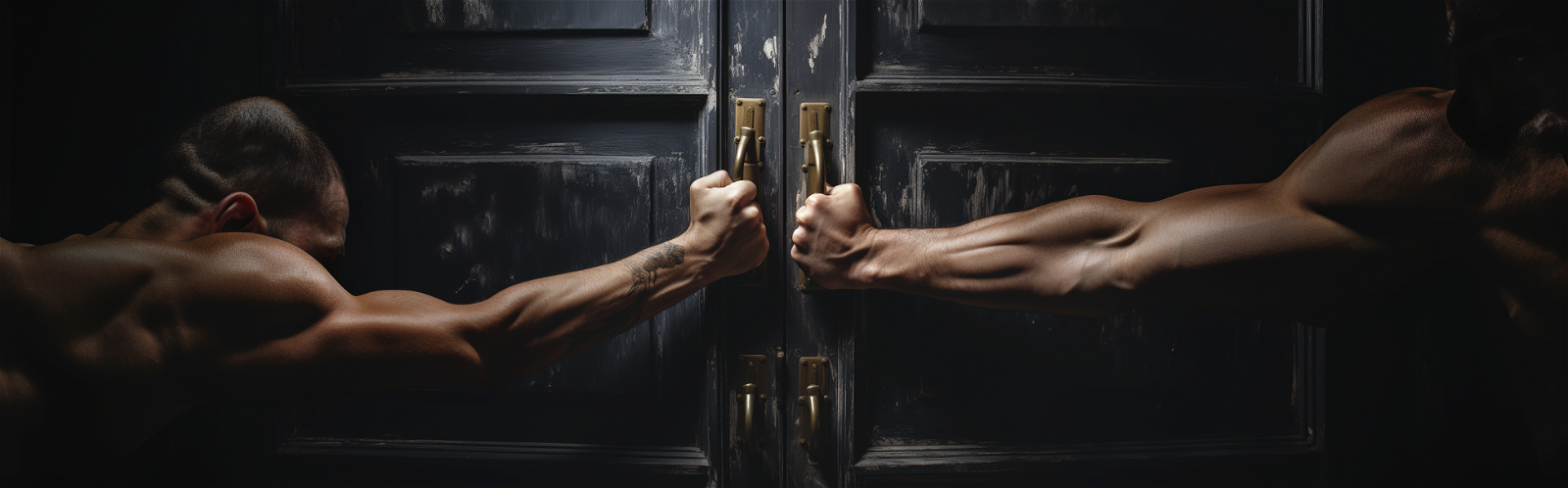
Knocking Sound Effects: Doors, Walls, Tables, and Tension

Knock knock. Who is there?
Knocking sound effects are short percussive cues that tell the audience someone, or something, is trying to cross a boundary. A knock can be friendly, threatening, comic, coded, intimate, official, or supernatural depending on the rhythm, surface, distance, and silence around it.
The useful question is not just what made the knock? It is what does the knock mean in this moment? A soft wall tap can feel secret. A fast fist on a door can feel urgent. A dry table knock can end an argument. A metal-tipped cane on a wall can turn a hiding place into a trap.
Below is a free +Sounds collection of royalty-free knocking sound effects, followed by film examples and practical editing notes for choosing, timing, layering, and mixing knocks in your own scenes.
| Knock type | What it usually tells the audience | Good sound choices |
|---|---|---|
| Single door knock | Someone is waiting for an answer. | Short knuckle knock with a natural room tail. |
| Rapid door knock | The visitor is impatient, scared, or trying not to be ignored. | Fast pattern with uneven spacing and stronger transient. |
| Soft wall tap | The message is private, coded, or coming through a barrier. | Hollow drywall tap, low volume, little high-end bite. |
| Heavy fist knock | Power, threat, authority, or confrontation. | Closed-fist knock with body and short low support. |
| Table or gavel knock | A decision, ending, ritual, or social signal. | Dry wood tap, close perspective, controlled decay. |
| Metal knock | Hardness, machinery, prison, pipe, cane, or comic exaggeration. | Bright metal tap with a small ring or sharp contact. |
Why knocking sounds work
A knock is suspense in miniature. It creates a question before it creates an answer. Who is outside? Why now? Should the character open the door? Does anyone else hear it?
Because a knock is normally short, timing carries a lot of the meaning. Put the same sound one beat earlier and it can interrupt. Put it after a pause and it can feel inevitable. Repeat it too evenly and it becomes mechanical. Let the spacing breathe and it starts to feel human.
Surface matters too. A hollow door knock suggests a room boundary. A drywall tap suggests someone on the other side of a shared wall. A table knock feels close and social. A metal knock can feel official, comic, industrial, or dangerous. The audience reads all of that before they consciously identify the object.
Door knocks in The Shining and The Matrix
In The Shining, Jack Nicholson turns a familiar door knock into a threat. The rhythm is not polite; it is unstable and performative. The sound lands before the violence, so the audience hears the boundary being tested before the door is destroyed.
That is the first lesson: a door knock does not need to be loud to be frightening. It needs to make the listener understand that a safe space may stop being safe.
In The Matrix, the words Knock, knock, Neo are followed by real knocks at the door. The sound effect connects the screen message to the physical world and makes Neo feel watched. A simple knock becomes proof that the mystery is not only in his computer.
For an editor, this is a good reminder that a knock can be a reveal. The sound can confirm information, connect two spaces, or make an unseen character suddenly present.
Wall knocks in romance, horror, and comedy
Wall knocks are usually more intimate than door knocks because they happen between people who are already near each other. They can feel playful, secret, lonely, or invasive.
In The Summer I Turned Pretty, soft knocks pass between neighboring rooms. The knocks are gentle enough to feel private and reassuring. The wall is a barrier, but the sound makes it feel thin.
Insidious: Chapter 3 uses a similar idea for the opposite emotion. A wall knock first reads as communication, then changes meaning when the character realizes the person she expected is not there. The same kind of hollow tap shifts from romantic to supernatural because the story changes who, or what, is on the other side.
In Who Framed Roger Rabbit, Judge Doom knocks with a metal-tipped cane while hunting for someone behind a wall. The sharper, harder contact is very different from a knuckle tap. It feels procedural and predatory, almost like the wall is being interrogated.
When you need a wall knock, decide whether the sound should feel human, coded, comic, or invasive. A bare finger tap and a cane tap can describe the same action while telling completely different stories.
Tables, gavels, chess, and quiet authority
A knock on a table is not usually about entry. It is about attention, judgment, ritual, or finality. That makes it useful in courtrooms, classrooms, meetings, games, and ceremonies.
A gavel is one of the clearest examples. It is small, dry, and official. The knock does not need cinematic weight because the institution around it gives the sound weight.
In chess, tipping or knocking over the king can be a tiny sound with huge meaning. The sound itself may be delicate, but the story tells the audience that the game has ended.
A Beautiful Mind turns small table contacts into respect. Pens are placed down one after another, each producing a gentle knock. The sequence works because the sounds are humble. If the effects were too large, the moment would become sentimental or false.
Body knocks and comic exaggeration
Knocking on body parts is rarely realistic. It is usually a joke, a ritual, or a stylized way to make a body feel hollow, tough, or absurd.
The Three Stooges often used head knocks as comic punctuation. The sound does not have to match bone or skin. In comedy, a hollow pop or wooden tap can be funnier because it exaggerates the idea of emptiness.
The Wolf of Wall Street uses repeated chest thumps as a group signal. The rhythm becomes social. For moments like this, the important choice is not one perfect knock. It is variation, spacing, and making sure the pattern supports the performance instead of burying it.
If you are designing body impacts, our punching sound effects and thud sound effects guides cover heavier contact and body-weight sounds in more detail.
Coded knocks and rhythm as information
Some knocks are not just sounds. They are messages. The audience does not need to decode every detail, but they should feel that the rhythm has intent.
In Stranger Things, tapping becomes language. The taps need to be readable enough that the characters can react to them, but they also need to sit inside the larger tension of the scene.
In Harry Potter and the Order of the Phoenix, three staff knocks open the entrance to Grimmauld Place. The sound is ritualized. It is not just contact; it is a key.
When a knock carries coded information, keep the pattern clean. A little room tone and distance are fine, but too much reverb or impact can smear the rhythm and make the message harder to read.
How to choose the right knocking sound effect
Start with the dramatic job, then choose the recording. Searching only for door knock is usually too broad. Search by surface, distance, and behavior too: soft knock, rapid knock, wood door, wall tap, metal tap, outside door, closed fist, knuckle, hollow, distant, interior, or coded rhythm.
| Scene need | Search for | Editing note |
|---|---|---|
| A polite visitor | Knuckle door knock, single knock, soft door knock | Use a natural room tail and leave a beat for response. |
| Urgency or panic | Rapid knock, fist knock, hard door knock | Let the rhythm crowd the dialogue or interrupt silence. |
| Private wall communication | Drywall tap, wall knock, finger tap | Keep it small and hollow. Too much bass ruins the intimacy. |
| Authority or finality | Gavel, table knock, wood tap | Dry and close often works better than huge and cinematic. |
| Threat behind a barrier | Outside door knock, heavy knock, metal tap, wall hit | Add distance or low support only if the shot can hold it. |
| Comedy | Hollow tap, cartoon knock, wood pop, metal ping | Cheat the realism if the joke gets clearer. |
Layering a knock without making it too big
Many good knocking sound effects are simple. A clean recording with the right timing will beat a complicated stack most of the time. But layering can help when the scene needs extra clarity or emotional color.
- Transient: the sharp first contact. This tells the audience exactly when the knock happens.
- Body: the short weight after the transient. This makes the door, wall, table, or object feel physical.
- Room: the space around the knock. This tells us whether the sound is close, distant, inside, outside, small, or empty.
- Character: the odd detail: a cane tip, ring, glove, fingernail, hollow panel, loose hinge, or metal edge.
For a scary knock, you might layer a normal knuckle knock with a very low, short wood thud and a dark room tail. For a comic knock, you might keep the natural knock but add a small hollow pop. For a realistic apartment scene, you may need no layer at all, just the right distance and a small amount of room tone.
Editing and mixing tips
- Cut for reaction. The knock often matters because of the face after it. Leave space for the character to hear it.
- Do not overfill silence. Silence before a knock can make it land harder than extra bass or reverb.
- Match the shot size. A close-up can support a detailed tap. A wide hallway may need more room and less dry contact.
- Vary repeated knocks. Copying the same knock three times can feel fake. Use alternate takes or adjust gain, timing, and pitch slightly.
- Watch the low end. A door knock can become a trailer hit if you add too much sub. That may be right for a horror reveal, but wrong for a natural scene.
- Keep dialogue clear. If the knock interrupts speech, it should do so intentionally. Use volume automation so it has impact without masking the line.
Common knocking sound mistakes
- Choosing only by object. A door knock can be polite, angry, distant, hollow, comic, or supernatural. Search by feeling and function too.
- Making every knock huge. Most knocks are small. If every sound has cinematic weight, the scene loses scale.
- Ignoring perspective. A dry close knock may feel wrong if the character is across the room.
- Looping one take. Repeated identical knocks are easy to hear. Use variations.
- Forgetting the response. The sound is only half the moment. The cut after the knock tells the audience what it meant.
FAQ
Where can I download royalty-free knocking sound effects?
You can download royalty-free knocking sound effects from Audio Design Desk and +Sounds. The embedded collection on this page includes door knocks, wood knocks, drywall taps, metal taps, and heavier wall hits for film, video, podcast, and game projects.
What makes a knocking sound effect scary?
A scary knock usually comes from context: silence before the knock, an unseen source, an uneven rhythm, distance, or a sound that does not match the expected person. Low layers and reverb can help, but timing and story do most of the work.
How do I make a door knock sound realistic?
Use a recording that matches the surface and distance in the shot, keep the rhythm human, avoid excessive low end, and add only enough room tone or reverb to place the sound in the space.
Can I use wall taps instead of door knocks?
Yes. Wall taps work well for secret communication, neighboring rooms, apartments, horror scenes, and coded messages. They should usually be smaller and more hollow than a door knock.
Should I layer knocking sound effects?
Layer only when the scene needs extra weight, clarity, or character. A simple knock often works best. If you layer, give each layer a job: transient, body, room, or character detail.
If you want a neighboring sound palette, see our door slamming sound effects, thud sound effects, and glass breaking sound effects guides.